
Wayne City Directory Holdings
Wayne has no verified, complete printed city-directory run in the official research. That distinction matters. The strongest local starting point is the Wayne Public Library and its digital archive, while the Passaic County Historical Society, or PCHS, supplies regional directories that can help establish movement through the county. The PCHS holdings page names several nearby municipalities but does not list Wayne. A volume for Paterson or a suburban area can be a useful lead, not proof that it covered a Wayne household.
The collection list below keeps the coverage limits visible. “Exact years not located” means the public landing page did not reveal them. Asking the holding institution for a date-indexed inventory is more reliable than filling a gap with a guessed year range.
| Collection | Years | Where | Access |
|---|---|---|---|
| Wayne digital newspapers | Exact years not located | Digifind-It Wayne | Public keyword search and category browse |
| Wayne Hills and Wayne Valley yearbooks | Exact years not located | Digifind-It and Wayne Public Library | Public browse; ask about physical runs |
| PCHS Paterson directories | 1856–1968, scattered runs | Lambert Castle library, Paterson | Appointment, admission, or research service |
| PCHS suburban volumes | 1956, 1957, 1959, 1961 | Lambert Castle library | Street and telephone pages; Wayne inclusion is not listed |
| Federal and New Jersey census material | Federal through 1950; state 1855–1915 | NJ State Archives and partner collections | Research room, microfilm, and online indexes |
Note: A directory title, even one bearing a county name, does not establish that every township appears inside.
Wayne City Directory Leads at the Library
Wayne Public Library’s local-history collection is the local contact point for a newspaper, yearbook, family, or old-address question. The library was established on July 24, 1923. Its Lockett Local History Room, named for S. Hobart Lockett, is appointment-only, so a visit should be arranged through the Reference Desk rather than assumed to be walk-in access. The main library is at 461 Valley Road, and the Reference Desk can be reached at 973-694-4272 ext. 5401 or fitzgeralda@waynepubliclibrary.org.
The public library page links its digital collection but does not publish a fully enumerated Wayne city directory shelf. Give the staff a defined name, street spelling, approximate year, and record type when asking about a printed directory, clipping, or local-history file. That request helps distinguish a search for a specific item from a broad request for information about a person.
Wayne Digital History Clues
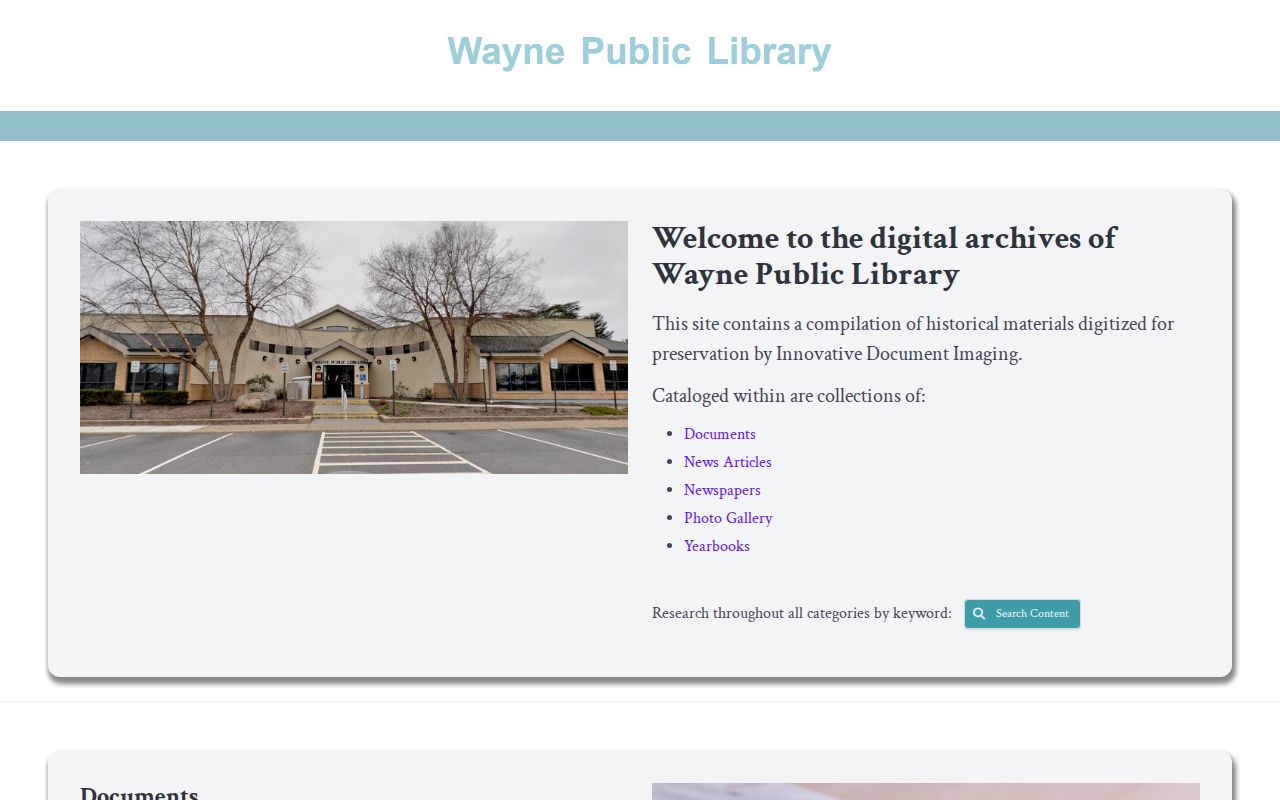
Digifind-It Wayne is not presented as a digitized run of Wayne city directories. It is still a strong companion source. Its visible categories include Documents, News Articles, Newspapers, Photo Gallery, Aerial Maps, Buildings, People, and yearbooks for Wayne Hills and Wayne Valley. Newspaper labels include Argus, Evening News, Herald News, Wayne Eagle, Wayne Today, and several Passaic Valley titles. The public landing page supports keyword search and category browsing, but it does not show exact years, date filters, item-level metadata, or an OCR quality statement.
The image below is from the Wayne digital local-history archive capture in the project source set.
A yearbook page can anchor a person to a school year, and a clipping can add a date or organization. Neither alone proves a present address. Search a surname with spelling variants, then take the date or organization to the library, PCHS, census, or a recorded document for confirmation.
Wayne City Directory Context at PCHS
PCHS directory holdings document a precise regional run: the 1856 Paterson Rays Directory, scattered Paterson volumes through 1968, and suburban volumes for 1956, 1957, 1959, and 1961. The holdings also name Paterson, Passaic, Haledon, Prospect Park, Little Falls, Totowa, Clifton, and West Paterson. Wayne is omitted from that list. Later publisher names were not visible in the inspected holdings page, so they should not be assigned without opening each title page.
PCHS is at Lambert Castle, 3 Valley Road in Paterson. Its library has city directories, maps, family group sheets, cemetery and church material, photographs, manuscripts, and surname files. On-site research is free to members and costs $5 for nonmembers, including museum admission. A written research request costs $25 for the first hour and up to 10 pages, with a stated four-to-six-week turnaround after payment. The reply includes a list of sources consulted and does not promise a result.
Wayne Printed-Collection Era Markers
The printed-history dates below describe PCHS holdings, not a continuous Wayne publication timeline. They help set an honest research boundary. A date attached to a Paterson or suburban volume is a prompt to inspect its title page and municipal coverage before using it for a Wayne household.
- 1856: PCHS lists the Paterson Rays Directory, its earliest named directory item.
- 1915: PCHS notes pink-page street material in Paterson directory volume 9.
- 1922: PCHS notes that volume 15 begins all towns and places streets in pink pages.
- 1956, 1957, 1959, and 1961: Listed suburban volumes provide street and telephone-page clues, but Wayne inclusion is not named.
- 1968: This is the last Paterson directory listed in the PCHS holdings page, not a final Wayne directory year.
There is no verified first Wayne city-directory year, no verified last Wayne printed year, and no located municipal coverage list for the regional volumes. That uncertainty should remain attached to every result.
Reading a Wayne City Directory Lead
No individual PCHS directory page was opened in the research, so no sample entry can honestly be expanded into occupation, spouse, owner, renter, widow, or abbreviation fields. What is verified is narrower: pink street pages use a street, house-number, and occupant approach, while green telephone pages in suburban volumes supply a telephone-number clue. The inventory below separates those observed features from fields that still require inspection of the actual volume.
| Street | Verified in PCHS pink-page descriptions as the starting order. |
|---|---|
| House number | Verified with street pages as an address-level locator. |
| Occupant | Verified as the person associated with a street-page listing. |
| Telephone clue | Green pages are described for suburban volumes. |
| Other entry fields | Occupation, spouse, owner or renter marks, widow notation, and abbreviations were not observed. |
Photograph or transcribe the title page, page number, and any abbreviation key once an actual volume is open. Preserve the street spelling and number exactly. A directory entry is a dated listing, not a deed and not a census return.
- Pink pages
- PCHS describes these as street listings that connect a named street and house number with an occupant.
- Green pages
- A separate telephone-number clue described for the suburban directory volumes.
- Householder index
- An index arranged around household names; whether a particular Wayne-related volume includes one must be checked in the book.
Pink Pages for Wayne Directory Research
The pink-page method works from place to name. Start with the street and the house number that appear in a deed, census, clipping, or family paper. Then inspect the appropriate street section for a listed occupant. PCHS notes that the 1922 Paterson directory begins all towns and places streets in pink pages, and it documents pink-page street material in a 1915 volume as well. That is a useful regional technique, but it does not resolve the missing evidence that Wayne itself appeared in those volumes.
Use green telephone pages as a separate clue, not a substitute for a confirmed address. A telephone listing can point toward a household or organization, while a recorded deed or tax record answers a different ownership question. For a current address-keyed inquiry, the Wayne street directory route uses municipal parcel and map records rather than rebuilding a historical shelf.
Trace Wayne City Directory Households
A Wayne city directory trail is most useful when each document supplies one dated fact. Begin with the earliest known spelling of a name, then record the street, number, initials, and any descriptive detail that is actually printed. Check the next available directory, newspaper, or yearbook rather than assuming every year exists. A missing name can mean a move, an unlisted household, a spelling change, or a collection gap.
- Start with a dated Wayne archive item, PCHS volume, or family record and write down the exact name and address form.
- Check the next available volume or street page for the same spelling and sensible variants.
- Pair that year with the nearest public federal or New Jersey census and retain the source date beside each fact.
- Use a deed recording date or tax record to test ownership, since a directory listing does not establish title.
- Use newspaper, cemetery, probate, or naturalization material to investigate a move, death, or family relationship.
Federal census access reaches 1950 under the 72-year rule. The State Archives also describes New Jersey state censuses from 1855 through 1915, with special schedules and Passaic material in several partner collections. A yearbook connects a student to an educational year, not necessarily every household member or a continuing residence.
Wayne Archives Beyond the Shelf
New Jersey State Archives genealogical collections add the records that printed directories cannot supply. The Archives describes federal census indexes from 1840 through 1950, New Jersey state censuses from 1855 through 1915, county deeds on microfilm through 1900, mortgages through 1850, wills and inventories, court records, naturalization material, and more than 8,000 newspaper reels. FamilySearch digitization is another route for county deeds.
Passaic County naturalization records run from 1837 to 1987 and include declarations, arrival certificates, petitions, and oaths. Certificates themselves follow a different route through USCIS. For pre-1906 naturalization, municipal, county, state, and federal courts could each have acted, so there is no single central index. This layered archive work is especially valuable when a Wayne digital item identifies only a surname or approximate era.
Note: Keep census, deed, directory, and clipping dates separate because each describes a different kind of connection.
Wayne City Directory Gaps and Requests
The known gaps are part of the answer. No official source located a first or last Wayne printed-directory year, a complete Wayne run, a digitized individual entry, or a verified publisher for later regional volumes. The Digifind-It landing page does not expose exact years, and PCHS’s list does not name Wayne among included municipalities. Do not turn a nearby city result into a Wayne address match without another record.
When a search stops, ask Wayne Public Library for the relevant local-history holdings and exact coverage. Ask PCHS for a narrowly defined surname, street, year range, or cemetery and church lead through its research-request process. State Archives research can then add census, deed, probate, or naturalization context. That sequence keeps a historical directory search tied to the custodian that actually holds the material.