
Tracing People Through Wayne Resident Records
Wayne is a township in Passaic County, so a useful resident trail moves among township offices, county records in Paterson, and statewide systems. Begin with the fact already in hand. An address is best for the assessment portal and public GIS; a confirmed owner name can lead to a recorded instrument; an older family question may start in the library archive. A result in any one source is a lead with a defined scope, rather than proof that a person currently lives at an address.
The public trail is incomplete by design. Assessment records describe taxed parcels, deeds describe transactions, court indexes describe cases where public access is allowed, and historical collections preserve a point in time. People who have no ownership, registration, filing, or archival appearance will not necessarily be visible. Keeping the record type and search date beside each result prevents a plausible match from becoming an unsupported conclusion.
- Run a confirmed Wayne address or owner name through the municipal assessment search and note the property address separately from any mailing address.
- Use the public GIS viewer to verify the parcel, block and lot, nearby map context, and the exact street spelling.
- Use New Jersey’s individual voter-status route only to check one person, not to assemble a street-wide roster.
- Follow a confirmed parcel key or legal description to the Passaic County Clerk’s land-record path and, if needed, the Registry Vault.
- For earlier households, search Wayne library material, State Archives resources, and historical directories only after confirming the collection actually covers Wayne.
Wayne Offices Behind Resident Record Leads
The Township handles the assessment, municipal records, planning material, and local vital-record routing. Passaic County keeps recorded land instruments and related maps in Paterson. State agencies control voter status, court search pathways, and many vital-record and archival processes. For an address-focused trail, the detailed Wayne street directory route keeps the parcel, map, and deed sequence together.
Passaic County Clerk Registry Division
Registry Vault, basement
77 Hamilton Street, Paterson, NJ
973-881-4785
Wayne Township Assessment
Town Hall
475 Valley Road, Wayne, NJ 07470
973-694-1800 ext. 3349
New Jersey Voter Information
State individual status check
Wayne and Passaic County registrants
Public tool for one person at a time
Wayne Parcel Search Fields That Narrow a Name
The Wayne assessor page links residential and commercial search routes, while the linked New Jersey tax-records portal exposes the usable field sequence. PASSAIC and WAYNE are prefilled as the county and district. Use Location when an address is known, Owner Name for a confirmed owner, and Block, Lot, and Qualifier when the street form is ambiguous. Search-format, output-format, and list-size controls are also present, although the inspected portal did not expose every option or a complete parcel-card field list.
| Wayne portal field | Best use | Important limit |
|---|---|---|
| Location | Start with a house number and street | Exact address syntax was not published in the inspected form |
| Owner Name | Find parcels associated with a confirmed owner | Partial-match behavior was not documented |
| Block and Lot | Bridge a parcel to GIS and legal-description research | Both may be needed for a unique parcel |
| Qualifier | Separate a qualified or multi-unit parcel where applicable | Do not omit it when a map record supplies one |
| Output controls | Choose a result display after the search criteria | Rendered output choices and limits were not captured |
A tax result is not a complete residents directory. The portal warns that recent SR1A information may still be unfinalized, that assessment is not evidence of value, and that not every sale is usable for assessment analysis. Its Daniel’s Law notice also warns against improper disclosure of protected officials’ information.
The Wayne assessor search interface is the starting screen captured for the Wayne Residents Directory.
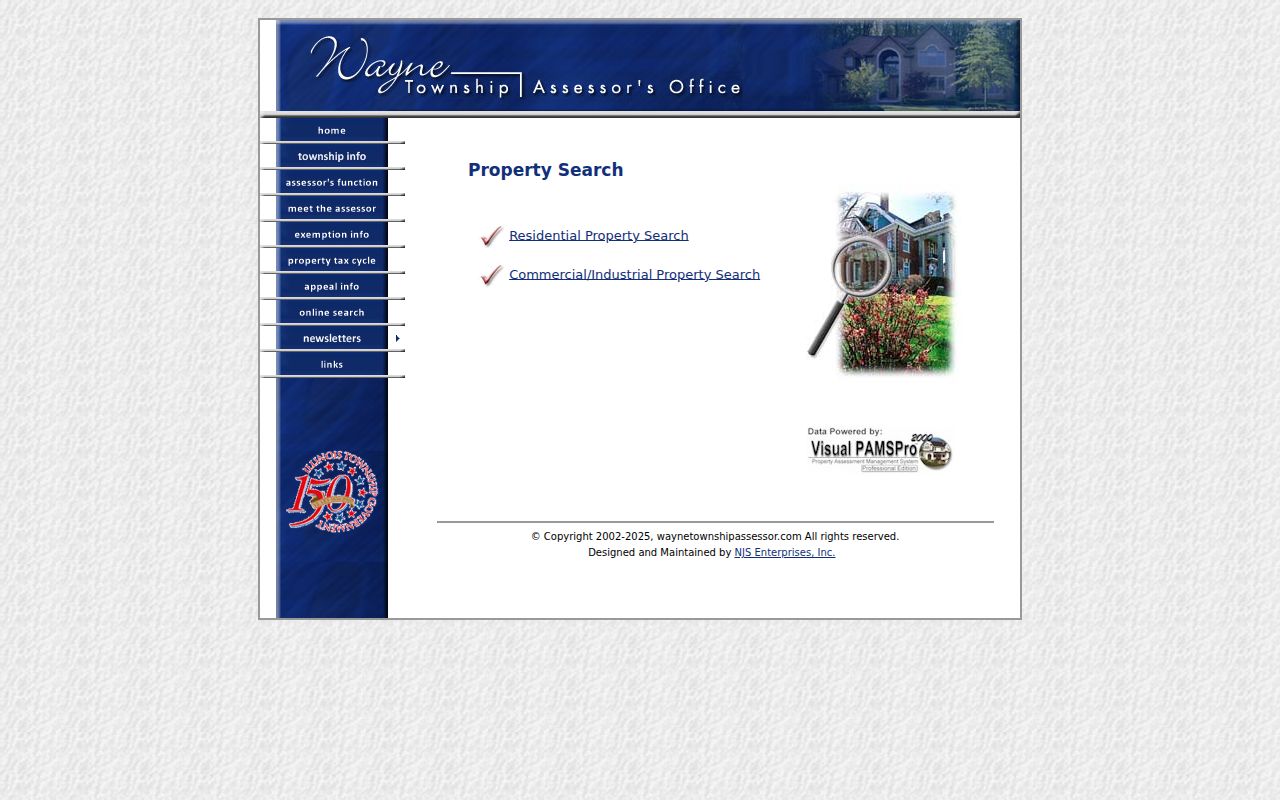
That view supports a careful field-by-field search, but the returned assessment record should be read as a parcel lead and corroborated with the map or recorded-document route.
Map a Wayne Address Before Following the Paper Trail
Wayne’s public GIS viewer offers Address Search, Block/Lot Search, Owner Search, Street Search, selected-result controls, and report tools. Its local parcel syntax is BLOCK-LOT(-QUALIFIER), with examples such as 900-1 and 2700-3-CA. An address search can verify whether a street entry points to the right geometry; a Block/Lot search can keep the parcel stable when formatting changes; and a Parcel Profile Report can return relevant surrounding attributes in PDF or Excel.
For a street or block question, the map can be locked to the current area, panned to a selected result, and reviewed alongside official street, zoning, flood, and voting ward/district maps. Mailing-label tools exist by address, block/lot, owner name, and street with a buffer choice. Those tools describe a selection feature, not a list of current occupants. The map shows spatial context, not household membership.
Wayne Township’s public GIS viewer documents the address, owner, parcel, and street tools used in a Wayne Residents Directory search.
Use the map result to capture the parcel key and address spelling before moving to an ownership or document search, especially where a lot has a qualifier or a parcel was subdivided.
Why a Wayne Record Search Often Ends in Paterson
One of Wayne’s record-keeping quirks is geographic: the address or parcel sits in the township, but recorded land documents are a Passaic County function centered in Paterson. The County Clerk’s Registry Vault at 77 Hamilton Street, basement, is the controlling local counter for deeds, mortgages, liens, easements, and recorded maps. The county page publishes both an online records-search entry and fee information, but the live search endpoint timed out during the research capture and no official online coverage year was located.
That access gap changes the workflow. Keep the owner name, block/lot, legal description, approximate year, and any instrument number or book/page found in prior material. If the web path is unavailable or an older result is needed, call the Registry Vault or Map Room rather than guessing a cutoff. The page header gives weekday hours beginning at 8:00 while its body describes regular Vault and Map Room hours beginning at 8:30, so confirm hours before travel. The Clerk does not perform title searches, and surveys are not recorded in the recording office.
Definition check. A parcel is the mapped taxed tract. The situs address is the property location. A mailing address is where correspondence goes and can be elsewhere. A criss-cross directory is an older reverse directory organized by street and number rather than surname.
Current Wayne Resident Directory Sources and Their Reach
There is no single official roster of everyone in Wayne. The sources below function more like separate directories, each tied to a legal purpose. The assessment and deed paths are strongest for ownership and transactions. The voter tool is a controlled individual confirmation. Planning and permit material can identify public applicants or address-specific activity when a public file exists. A source should be chosen for the question it can actually answer.
| Wayne record source | People or address connection | Custodian | Access route |
|---|---|---|---|
| Assessment search | Current assessed owner and parcel lead | Wayne Assessment | Public search portal |
| GIS parcel viewer | Address, block/lot, street, map context | Wayne Township | Public viewer and PDF/Excel reports |
| Recorded documents | Grantors, grantees, legal descriptions, recording placement | Passaic County Clerk | Online route when available, Vault or Map Room fallback |
| Individual voter check | One person’s registration-status confirmation | New Jersey voter system | Public individual tool; protected data withheld |
| Planning and inspection trail | Public applicants, owners, reviews, or address-linked activity | Wayne departments | Document library, citizen portal, or focused OPRA request |
| Library and archive material | Historical names, yearbooks, newspapers, and address-era clues | Wayne Public Library and archives | Digital search or local-history appointment |
For a one-person sequence, match the record type to the second identifying fact: an address, parcel, approximate year, organization, family relationship, or court county. The linked resident lookup guide takes that evidence-first approach rather than treating a same-name result as a match.
Wayne Voter Status Is an Individual Confirmation
New Jersey’s public “Am I Registered?” route is intended to verify one person’s status. The form returned a 403 during inspection, but the state voter-registration page confirms the status-tool route. The statute at N.J.S.A. 19:31-39 describes a deeper statewide system containing address, municipality, ZIP, ward/district, party where designated, registration date, and ten-year participation fields. That broader system does not turn the public checker into a browseable neighborhood list.
A county voter list has its own statutory request pathway. The research notes a uniform reproduction charge not exceeding $375 for a requesting voter, while signatures, identification numbers, and approved protected-person home addresses are withheld. This distinction matters: an individual confirmation can corroborate a supplied identity, but it should not be used to infer every resident along a road.
New Jersey’s individual voter lookup is shown here as a Wayne Residents Directory verification channel.
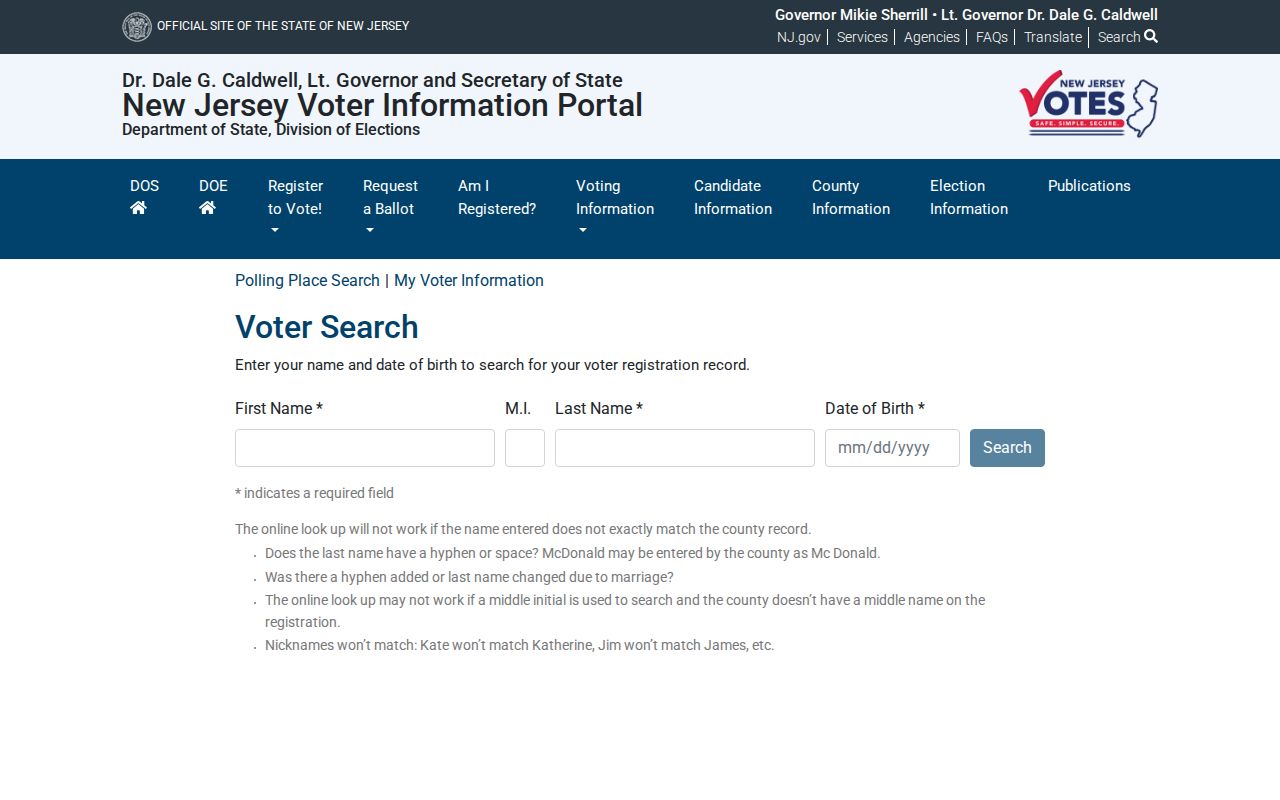
When the public form does not load or a protected address is involved, stop rather than substituting an unrelated address record for voter confirmation.
Wayne and State Court Records Need a Separate Check
Wayne Municipal Court handles local ordinance, code, traffic, and disorderly-person matters. New Jersey Courts provides separate statewide paths for civil, criminal, judgment-lien, and Tax Court searches. A public docket can show that a case exists or identify a party, but the record must be compared against middle initials, municipality, date, and disposition before it is associated with a particular person. Sealed, expunged, juvenile, family, and other protected matters remain outside ordinary public access.
NJMCDirect is not a broad name directory. State self-help instructions describe ticket searching with a court ID, ticket number, and license number; a person without a ticket is directed to the local court or state assistance. Full case files and certified copies follow the court’s separate request process, including Form CN 10200 where applicable. Court access is therefore a verification branch, not a shortcut around record restrictions.
New Jersey Courts search choices show the distinct court pathways relevant to a Wayne Residents Directory lead.
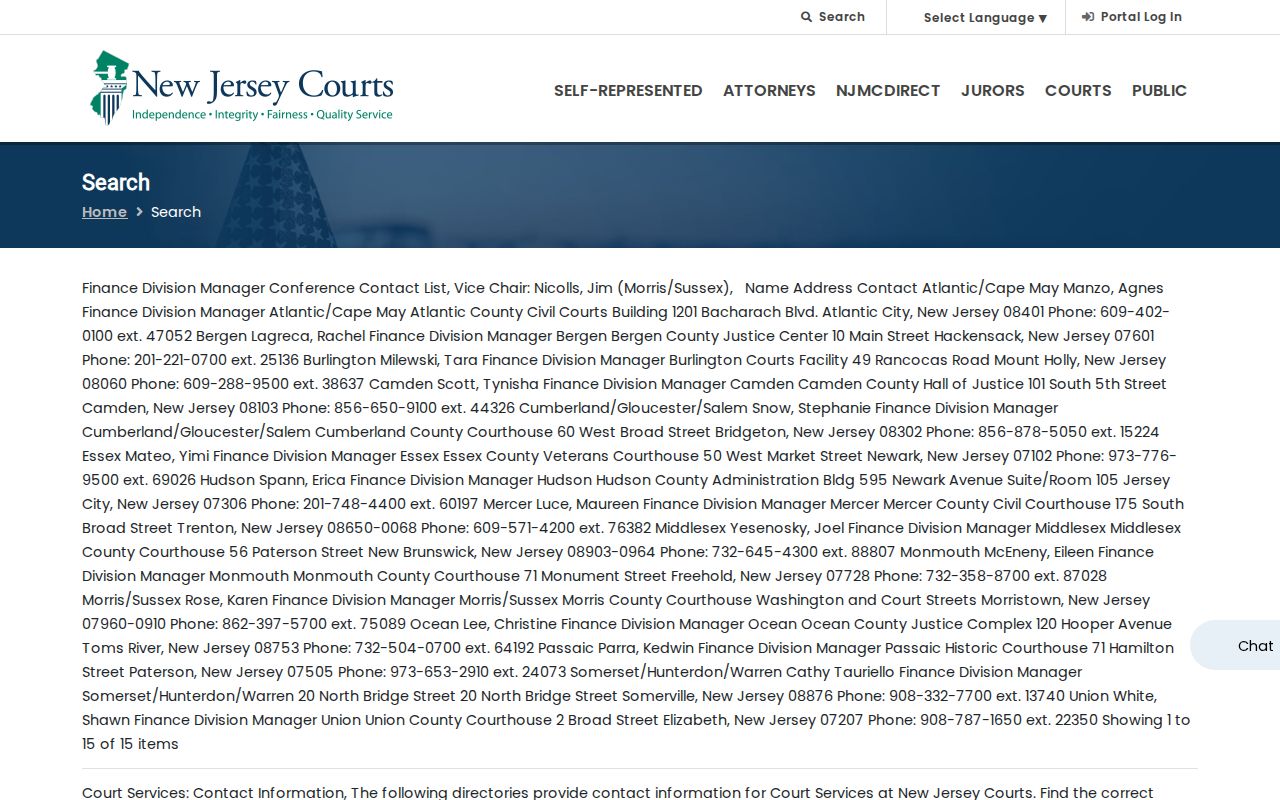
The separate court categories help keep a municipal matter, statewide civil case, and restricted file from being described as the same kind of record.
Use Two Anchors Before Treating a Wayne Name as a Match
A name becomes more reliable when paired with something independent: a parcel key, street, approximate year, business filing, family connection, docket number, or school-era record. Start by noting spelling variants, middle initials, suffixes, former names, and abbreviated forms. Then preserve exactly what each source says. A recorded deed can show a party to a transfer; it does not establish daily presence at the property. A tax mailing address can point to a correspondence destination; it does not replace the property location.
The same discipline helps with a no-result. A blank assessor search may mean an address-format problem or qualified lot. A blank County Clerk screen may reflect the documented web-access gap. A blank court search can result from restrictions. A vital-record search is intentionally not an open online name index. Naming the stopped channel makes the next lawful route clearer: another official custodian, an archive, a narrow request, or no disclosure.
Official Wayne Records and Compiled Search Results Are Not Alike
Official sources have narrow scopes and traceable custodians. The Wayne assessment portal identifies a property record; the GIS viewer relates an address to a map parcel; the County Clerk holds recorded instruments; the state voter route checks an individual status; and the library preserves historical material. A commercial compiled profile may combine older addresses, marketing data, and public-record fragments, but it can merge same-name people, omit protected records, or retain stale information.
For family history, reconnecting with a past classmate through archival material, estate research, or checking a property transaction, the official source is the stronger evidence. If a compiled result suggests a lead, verify it independently with the actual custodian. Correction requests to a commercial compiler do not erase the underlying lawful public record, and a source with no known custodian offers little way to assess its date or method.
The 80, 50, and 40-Year Wayne Vital Record Path
Vital records are not a public resident roll. For a Wayne event, begin with the Township Vital Statistics Division at Town Hall, then use the New Jersey Department of Health for state-held records and the State Archives for the older period. The Department says vital records cannot be searched online under New Jersey law. Its genealogical route generally applies to a birth more than 80 years old, a marriage more than 50 years old, and a death more than 40 years old, subject to eligibility and identification rules.
The current state office holds births from 1925 and marriages and deaths from 1951, while the State Archives holds older historical copies. The genealogical application asks for the person’s name, event place and year, requester identification, payment, and relationship proof where a certified copy is sought. A limited informational certification is different from a certified legal record, and the right procedure depends on the record era and purpose.
New Jersey’s genealogical vital-record guidance is the source captured for the Wayne Residents Directory thresholds.
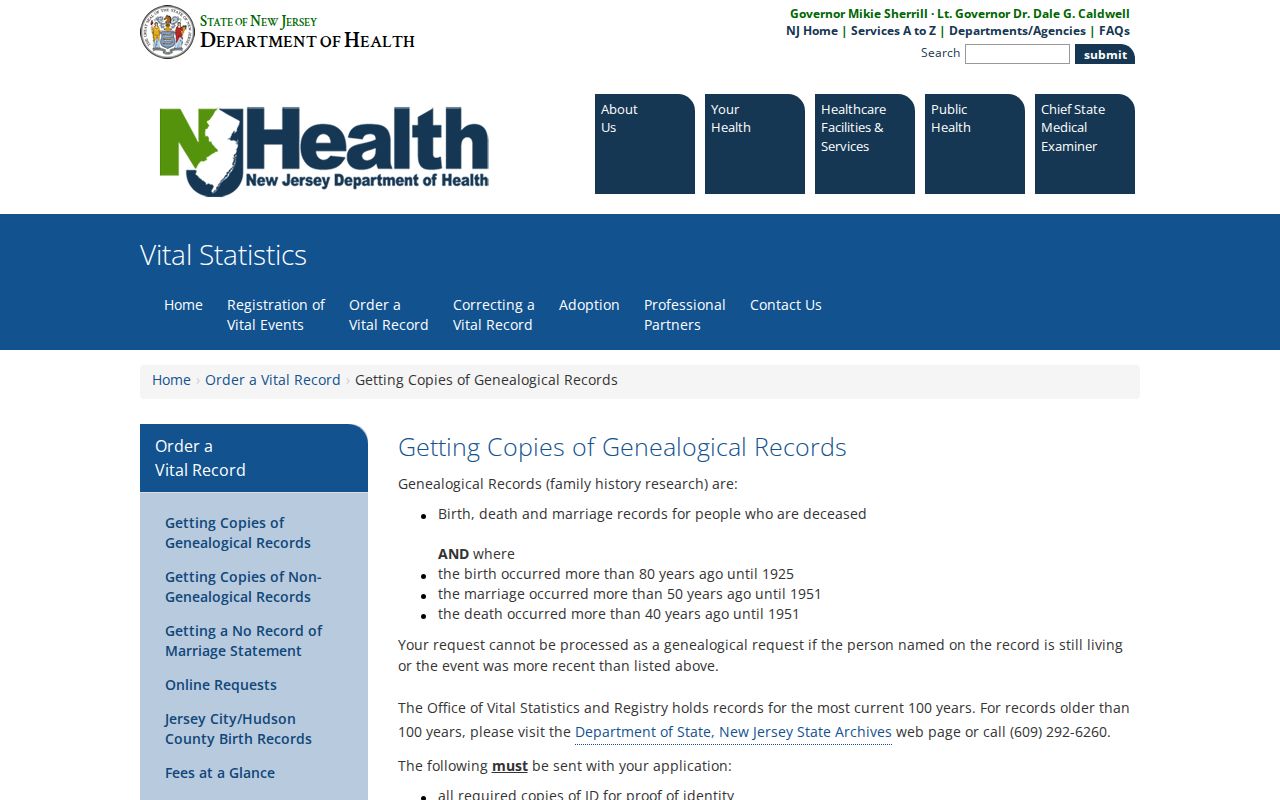
The threshold screen belongs in a historical-research workflow, not in a claim that current birth, marriage, or death records can be searched by name online.
Passaic County’s Property-Fraud Alert Adds an Instrument Check
Passaic County promotes a free Property Fraud Warning System through Landex. An alert recipient can verify an alert by instrument number on the Clerk’s property-search route. The alert is useful for recognizing a recorded-document event connected to a property, but it is not a title search and it does not establish who occupies a property. Compare the instrument number, party names, recording placement, and legal description with the Clerk’s record.
The county’s published fee schedule remains the place to check current copy and recording costs. Research also found a 2025 transfer-fee update for transactions above one million dollars, which is another reason not to repeat a historical fee as if it were permanent. The Registry Vault and Map Room remain the practical follow-up when the online endpoint does not reveal what is needed.
Historical Wayne Resident Directory Starting Points
Wayne Public Library’s Lockett Local History Room is an appointment-only local starting point, with a searchable Digifind-It archive for documents, newspapers, photographs, aerial maps, and Wayne Hills and Wayne Valley yearbooks. Search a historical street, name, or organization in the archive, then ask the Reference Desk for date coverage and physical holdings when the online category does not answer the question. The local-history collection is stronger evidence for an era than for a current address.
Passaic County Historical Society preserves a substantial directory and genealogy collection at Lambert Castle, but its published directory-holdings list names Paterson, Passaic, Haledon, Prospect Park, Little Falls, Totowa, Clifton, and West Paterson rather than Wayne. Pink street pages can provide house-number and occupant clues and green pages telephone clues only after a volume’s municipal coverage has been checked. The fuller collection discussion belongs with the Wayne city-directory materials.
When the Wayne Directory Trail Reaches the Archive
The historical fallback is layered. New Jersey State Archives describes federal census access through 1950, state census material from 1855 through 1915, and 1885 Passaic material among its research paths. It also holds microfilm of county deeds through 1900 and points to digitized county deed books through FamilySearch. A pre-digital address trail may therefore move from a current parcel key to a deed, a census snapshot, a newspaper notice, and a local-history request rather than from one modern database to another.
Use each collection’s date and geography as part of the citation. Wayne’s digital archive does not publish a complete visible date inventory on its landing page; PCHS does not promise a Wayne printed-directory run; and no official Wayne street-renumbering year was located. If an old number does not match, compare the legal description, block/lot, subdivision, nearest road, and original place wording before assuming a renamed street. This careful archive route keeps the Wayne residents directory useful without inventing coverage it cannot support.
Lawful personal research only. Use public records for family history, an estate matter, civic curiosity, or another lawful purpose. Do not use address or identity clues to stalk, harass, intimidate, or harm anyone. Address Confidentiality Program and Daniel’s Law protections can lawfully limit what a custodian releases.